


{SECTION_MENU}
Year 5
Welcome to Year 5
Mrs Cornish is the Year 5 teacher and Mrs Ilyas is the teaching assistant, supported by Mrs Warden.
In Year 5 there will be lots of new topics to explore, including space in science; rivers in geography; the Ancient Greeks in history and baking scones in DT.
We encourage home learning to be completed weekly. Times table and spelling practice as well as reading are compulsory. Regular reading is vital as it helps us to learn new vocabulary and notice how many different ways there are to construct a sentence. Keep reading together at home, as well as independently.
In Year 5, we take pride in putting in 100 percent effort. We celebrate the ‘have a go’ attitude. Someone once said, “If you haven’t failed, you haven’t tried.” We value the efforts all parents give to the development of their children.
Year 5 Curriculum Overviews
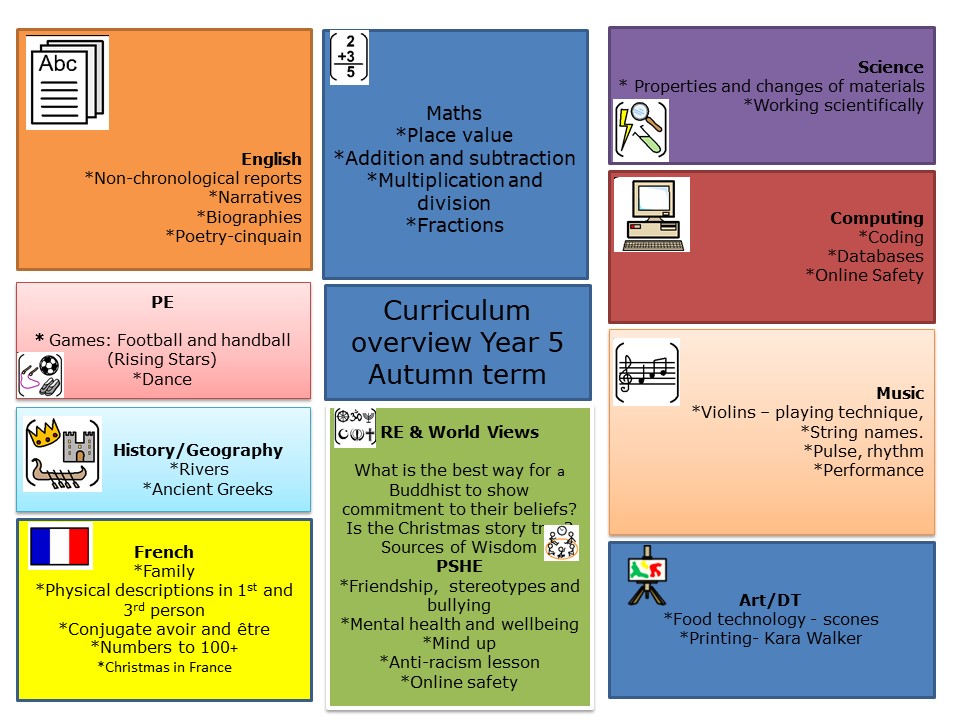
Year 5 Information
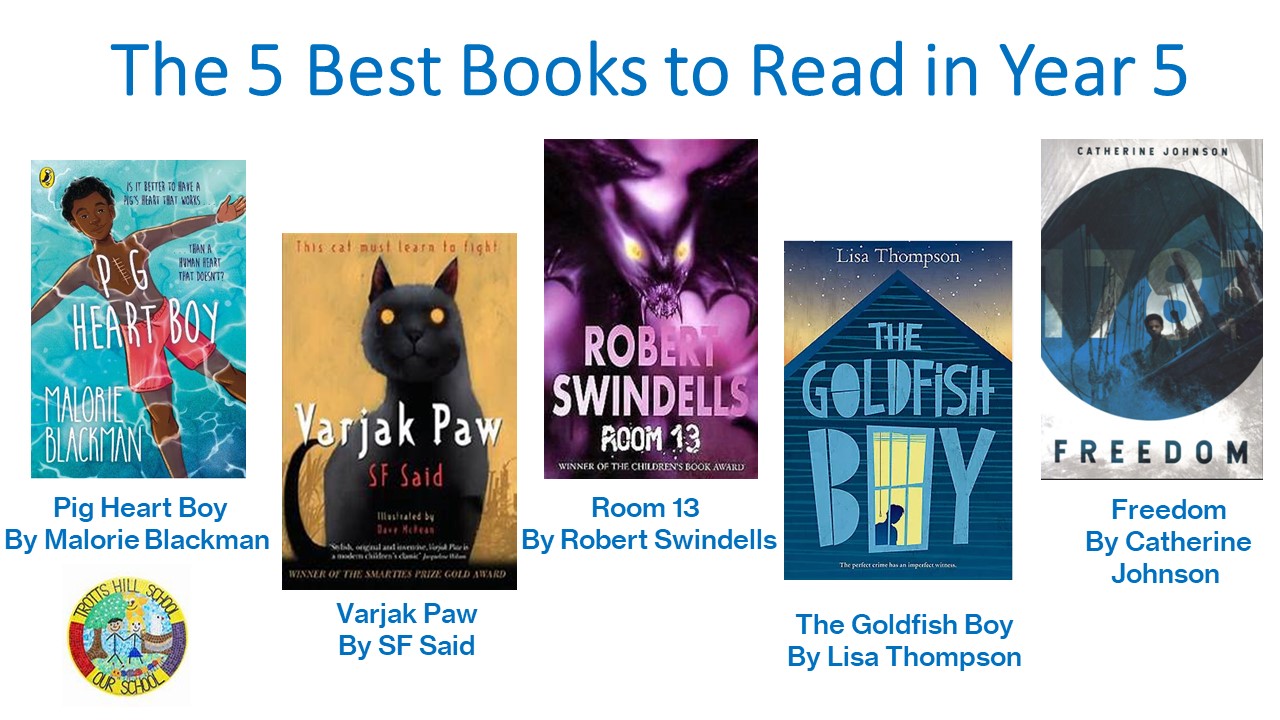
Year 5 - 5 Best Books
2026-2027
Week beginning 21st September
Geography Rivers Trip
On Tuesday we travelled to the Lea Valley Country Park to enhance our geography learning about rivers. After lots of singing on the bus on the way (including a rendition of Happy Birthday for Mrs Warden) we were met by Nicola from the Lea Valley Park Education Team. She told us some facts about the River Lea - the source of which is in Luton - and we joined in the description by using actions for some of the key vocabulary. She took us to various interesting points along the river and we stopped to make field sketches of meanders and man-made flood channels along the route. We had a list of items to spot whilst we walked which included a number of birds and trees as well as features of the river.
After lunch, we went to the visitor centre and were able to use binoculars to spot the wildlife on and around the lake which is man-made and was previously a gravel pit. There were lots of interactive exhibits and activities to do there and for many of the children, using the binoculars to get a close-up view of the wildfowl was the highlight of their day.


Week beginning 14th September
LI: To recognise the place value of numbers to 1,000,000
To help with remembering the place value of 7 digit numbers, we played "Crooked Millionaire." The children took turns to roll a die and had to place the number rolled either on their own place value chart, or on their partner's. The aim of the game was to create the largest number possible. They then had to write the number in words.


Week beginning 7th September
LI: To explore non-chronological reports
This week in English, we began our "Monsters" topic. Over the coming weeks, we will be exploring how grammatical choices can make a text more interesting to read; finding out about monsters and mythical creatures before creating and then writing about our own creatures. We started by looking at our two core texts and identifying the features of a non-chronological report.


Week beginning 31st August
Welcome back for the new school year.
LI: To identify a range of river features
This week, Year 5 began their geography topic of rivers. We watched a video following the journey of the River Severn from source to mouth and then worked in groups to label diagrams with all the definitions of the new vocabulary.


2025-2026
Week beginning 13th July
L.I To perform to an audience
Year 5 demonstrated their violin skills to parents and carers. They used the skills of pizzicato, bowing and using the first finger to change pitch.


Week beginning 6th July
L.I To plan a recount
As part of our Macbeth unit, the children took on the role as crime scene officers after the murder of King Duncan.


Week beginning 22nd June
The children showed lots of resilience this week when learning in the heat wave. They sat with their feet in water to keep cool in the afternoon. Guided reading took place outside so they could benefit from the morning breeze.


Week beginning 15th June
Year 5 put their strength, agility and stamina to the test during a FitKidz session.


Week beginning 8th June
L.I To improve comprehension
Year 5 worked with Year 6 pupils to improve their comprehension skills. They received tips about where to look in the text for their answers and how to phrase them.


Week beginning 1st June
L.I To understand how to combat racism
Stevenage Borough footballers delivered a workshop about anti-racism to Year 5. They learned how to be an ally to create equality.


Week beginning 11th May
L. I To understand how exercise can be good for mental health
Year 5 took part in the live Big School Work out with Joe Wicks.


Week beginning 4th May
L.I To understand the real life applications of science
The children visited AstraZeneca to find out how medicines are made. While on a tour of the site, they used the scenario of the fictitious disease 'unicorniosis' to track the development of a medicine to treat it.


Week beginning 27th April
L.I To understand how close the Vikings came to ruling all of England
The children looked at different key events and made judgements about how close the Vikings came to taking over England. They laid their statements on a graph to illustrate their decision making.
Week beginning 20th April
L.I To create an automata
The children designed an automata for the World Wildlife Fund to increase awareness of endangered species. They used tools to measure and cut dowel and carefully attached their chosen cam mechanism before decorating the box to reflect the environment.


Week beginning 16th March
Le chat en chocolat
This week in French, we learnt a poem and a song to help us perfect our pronunciation. We focused on the vowel sounds and the French ch which is softer then the ch phoneme in English. We enjoyed singing and dancing to Le Chat en Chocolat. We hope you enjoy this short clip from our lesson.
Week beginning 9th March
L.I To play through balls in hockey
In hockey, the children learned to find space to play a through ball, making as many passes as possible.


Week beginning 2nd March
L.I To design and build a rocket using Knex
Year 5 worked as engineers today to design an build a rocket, with detachable booster and capsule. They worked in pairs, problem solving when they found their initial ideas didn't work. At the end, they presented their models to the class.

Week beginning 23rd February
L.I To learn first aid
Stevenage Sporting Futures delivered some first aid training to Year 5. They learnt about how to check for signs of breathing, the recovery position and how to administer CPR. Then, they were trained in how to use a defibrillator.


Week beginning 9th February
L.I To learn about the moon and forces
The children had an out of this world experience at Airbus in Stevenage. They made a moon box and had immense fun learning about 3 of Newtons Laws of motion. In addition, they found out about the work being done in their own town to advance space exploration and saw Mars Rover prototypes with their own eyes.


Week beginning 2nd February
L.I To learn about the Ancient Greeks through drama
The children enjoyed an afternoon of drama workshops run by the students of Oaklands College. The session culminated in a 'Horrible Histories' like performance which Year 5 pupils thoroughly enjoyed. At the end, they joined in with the dance they had learned in the workshop.


Week beginning 26th January
Using maps of different scales the children used location clues to place towns and cities of the UK on map. They also calculated the distance between and describe their location in relation to others using compass directions.


Week beginning 19th January
L.I To use inference
Year 5 children are building their reading stamina and use the skill of inference using evidence from the text.


Week beginning 12th January
L.I To use a forehand shot in 2 vs 2 table tennis
The children practised forehand shots.


Week beginning 6th January
L.I To understand the relative distance of the planets to the Sun
Using scaled down measurements, the children modelled the relative distance of the planets and, having made predictions, considered whether there was any pattern.


Week beginning 15th December
L.I To perform
The children delivered a first rate performance in the Christmas Showcase rehearsals.


Week beginning 1st December
L.I To make scones
The children followed a recipe to make gluten and dairy free scones. They made their own decisions about the flavourings they would like to use to enhance the taste.


Week beginning 24th November
Year 5 had their first rehearsal of Christmas Bells on the stage. They are now at the stage of perfecting their movements for a snappy and precise tango.


Week beginning 17th November
L.I To explain the different types of abuse and know who to talk to if I need help
The NSPCC delivered a workshop to Year 5. They discussed the different types of abuse and that children could recognise it as abuse if it makes them feel unsafe, scared or anxious. The children learnt that they shouldn't keep a secret if they are threatened to keep it, it has no end and makes them feel unsafe. They rehearsed the number for Child Line and learn about the service it provides.


Week beginning 10th November
L.I To recognise different types of bullying behaviour and what to do about it
Kidscape provided an excellent workshop to combat bullying. They learned that how to recognise bullying and how a ringleader of bullying behaviour has others who enable it by being a reinforcer, assistant or bystander. Bullying behaviour is successful when there is an imbalance of power. The children were taught to change the imbalance by recognising the roles and making sure that they become defenders and tell an adult.


Week beginning 3rd November
L.I To use a bow
In violin, the children learned how to hold a bow correctly and play on open strings.


Week beginning 20th October
L.I To create a negative and positive image
The children carved a design on one side of a tile and on the other carved the same image in negative relief. They printed their tiles as an individual image and then as a whole class piece. They evaluated their art work.


Week beginning 13th October
L.I To learn strategies to manage negative feelings
The children participated in a yoga class. Importantly, the learned some breathing techniques that could help them feel calm and grounded when negative feelings bubble to the surface. They also undertook a doodling activity to express their emotions.


Week beginning 6th October
L.I To understand the causes and impact of flooding
The children role played being town planners considering a new settlement by a river which is prone to flooding. They justified where they would put fields, schools, housing, factories, parks etc in order to minimise the risk to the community.


Week beginning 29th September
L.I To understand the off-side rule in tag rugby
The children learnt to have awareness of the position of the ball so as not to infringe the offside rule.


Week beginning 25th September
To create a database
The children read a text about mythical creatures and grouped the information. They designed and created a database, deciding on whether validation tools such as a menu of choices should be used.


Week beginning 15th September
L.I To carry out field work
Following on from classroom learning, Year 5 visited Lea Valley Park to look at river features first hand. The children undertook some field work sketches of a river meander and a navigation. As luck would have it, when we arrived at the lock on the navigation, a narrow boat arrived at everyone watched in fascination as the skipper opened and closed gates to allow the water level to drop so he could continue his journey.


Week beginning 8th September
L.I To learn about the features of a river
After learning about how a river changes from source to mouth, the children made models to demonstrate their new knowledge.


